Order enough custom poly bags to cover your weekly usage until a reorder can arrive, plus a buffer for waste, samples and peak weeks. Customized Poly Bags accepts orders from a minimum of 12, so first-time buyers can start small, confirm fit and print, then size larger runs of poly bags from real usage instead of guesses.
- Count poly bags per item and per bag style, not per order.
- Add a buffer for torn, missealed and sample bags.
- Set a reorder point that covers about 2 weeks of production plus shipping.
- Minimum order 12, free mockup within 24 hours, pay nothing until you approve.
How many custom poly bags should you order for a first run?
For a first run of custom poly bags, order enough to cover your expected shipments until a reorder could realistically arrive, plus a cushion for packing mistakes and growth. Customized Poly Bags accepts orders from a minimum of 12, so you can start small, confirm the size and print work for your products, and scale up once you have real usage data.
The right number is less about a magic figure and more about three things you already know: how many orders or units you pack in a normal week, how long a reorder takes to land, and how much storage space you can spare. Standard production takes about 2 weeks after you approve your mockup, so your first run should comfortably carry you through that window and then some.
A simple way to frame it: count the poly bags you will use in the weeks between today and your second delivery, then add a buffer. If you are launching a new product and have no sales history, lean toward a smaller first run and treat it as a test of fit, print and customer reaction.
How do you calculate poly bag usage from your order volume?
To calculate poly bag usage, multiply the number of items you pack in a typical week by how many bags each item consumes, then multiply by the weeks you want the order to cover. Poly bags are often used more than once per order, so counting bags per item, not per order, gives a far more accurate quantity.
Walk through your packing line and note every place a bag appears. An apparel brand might put each garment in a garment poly bag with a hang hole, then place a multi-item order inside a larger bag. A jewelry seller might bag each piece separately in a small resealable bag. A retailer selling on pegs might use a header card poly bag for every unit on display.
- List each product or SKU that ships in a custom poly bag.
- Note how many bags of each style one unit uses.
- Estimate weekly units for each product from recent sales.
- Multiply by the weeks of cover you want, then add a waste buffer.
Doing this per bag style matters because a self-seal flat poly bag and a frosted boutique poly bag are separate print runs with separate counts.
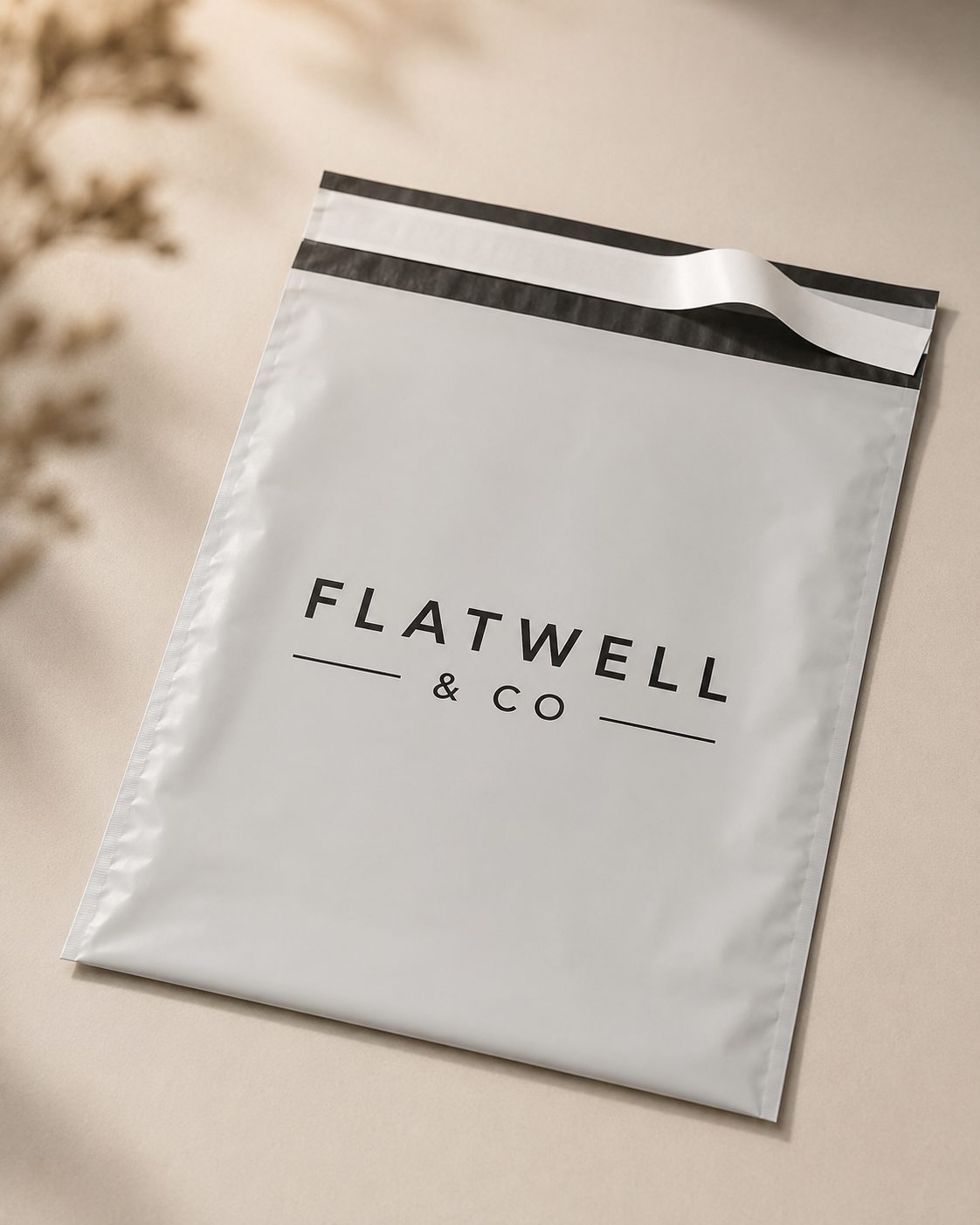
How much extra should you order to cover waste and mistakes?
Plan for some custom poly bags to never reach a customer. Bags get torn when a zipper snags, sealed shut before the product goes in, used for samples, or set aside for photography and marketing. Ordering a modest buffer above your calculated usage keeps a few bad days on the packing table from forcing an emergency reorder.
The size of that buffer depends on your operation. A busy fulfillment team packing fast with self-seal strips tends to waste more bags than a small studio packing by hand. New staff, new products and seasonal temporary help all raise waste for a while. Resealable bags with zipper tracks can be reused when a packer makes a mistake, while a self-seal adhesive strip usually cannot.
Also set aside poly bags for uses outside daily shipping:
- Product photography and listing images.
- Samples sent to wholesale buyers or influencers.
- Pop-up shops, markets and in-person events.
- Replacement shipments for lost or damaged orders.
Counting these upfront keeps your shipping stock from quietly shrinking faster than your sales numbers suggest.
Should you order one large run of poly bags or several smaller ones?
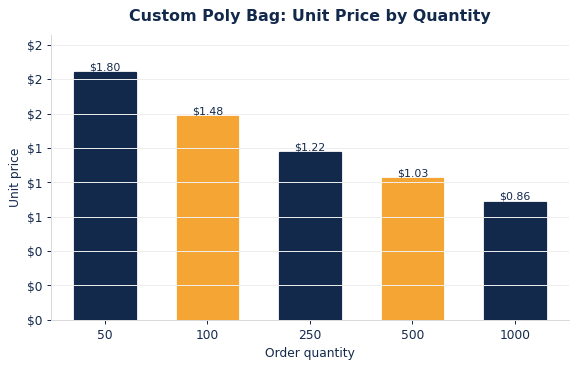
Choose one larger run of custom poly bags when your design, sizes and sales are stable, and several smaller runs when anything is still changing. Larger runs generally lower the cost of each bag and mean fewer reorders to manage. Smaller runs protect you from being stuck with bags that carry an old logo, an outdated website address or a size that no longer fits.
| Situation | Better approach | Why |
|---|---|---|
| Established product, steady sales | Larger run | Predictable usage, fewer reorders |
| New product or new brand | Smaller first run | Test fit, print and demand first |
| Rebrand or new logo coming | Smaller run | Avoid printed stock you cannot use |
| Seasonal or limited collection | Run sized to the season | Bags may not suit the next collection |
| Limited storage space | Several smaller runs | Keep stock manageable on site |
Customized Poly Bags quotes each run on its own, so you can ask for a quote at two different quantities and compare before deciding. Price is driven by quantity, bag style, size, thickness and the number of ink colors, and the quote form lets you see how those trade off for your order.
When should you reorder custom poly bags so you never run out?
Reorder custom poly bags when your remaining stock would last only slightly longer than the time a new run takes to arrive. Because standard production takes about 2 weeks after approval, plus shipping, set a reorder point that leaves room for that window and a little more. Faster turnaround is available with express shipping, but planning ahead avoids paying for speed.
A reorder point is a simple count you watch on the shelf. When the stock of a bag style falls to that count, you request a new run. Work it out from the same weekly usage you calculated earlier: weekly usage multiplied by the weeks a reorder takes, plus your safety buffer.
Reorders are usually quicker to set up than a first order because your artwork and sizes are already on file. Still, review the mockup each time. If your website, social handle, care instructions or warning text has changed, a reorder is the moment to update them rather than reprint old details.
- Mark the reorder point on the shelf or bin for each bag style.
- Check stock on the same day each week.
- Request a new mockup before peak periods, not during them.
How should you split a poly bag order across sizes and styles?
Split a custom poly bag order by matching each size and style to the products that actually use it, in proportion to how often those products sell. Ordering every size in equal amounts is the most common way brands end up with stacks of an unused size and a shortage of the one their best seller needs.
Start with your top sellers. If most of your volume is a single t-shirt style, the garment poly bag that fits it deserves the largest share. Accessories and add-ons that sell less often can share a smaller bag size. Products sold on retail pegs need header card poly bags, while items shipped directly to customers may only need a self-seal flat poly bag.
Consider whether one size can do the job of two. A slightly larger bag that fits both a folded tee and a hoodie can simplify ordering and reduce leftovers, as long as the fit still looks tidy and the logo stays visible. Your mockup from Customized Poly Bags shows the print on each style, which helps you decide where consolidation makes sense.
Revisit the split every reorder. Sales mix changes with seasons and new launches, and your bag quantities should follow it.
What quantity mistakes do brands make with custom poly bags?
The most common quantity mistakes with custom poly bags are ordering for the best case instead of the typical case, forgetting peak-season demand, and printing details that will soon change. Each one leads either to dead stock or to a rushed reorder, and both cost more than a little planning upfront.
- Ordering on hope. Sizing a first run to a sales target rather than real orders often leaves boxes of unused bags.
- Ignoring peaks. Holiday, back-to-school and promotion periods can multiply usage. Plan the run before the rush, not in the middle of it.
- Printing temporary details. Promo codes, seasonal slogans or a soon-to-change address shorten the useful life of a large run.
- Equal splits across sizes. Matching quantities to sales mix avoids shortages in your busiest size.
- No buffer for waste. Torn, missealed and sample bags add up quickly on a busy packing table.
Keep evergreen elements, such as your logo and website, on the main run. If you want seasonal messaging, consider a separate, smaller run sized only for that campaign.
How do you get an accurate quote for the right quantity?
To get an accurate quote for custom poly bags, send Customized Poly Bags your bag style, approximate size, the products going inside, your logo, and one or two quantities you are considering. Quoting two quantities side by side is the fastest way to see whether a larger run is worth the extra storage.
Include how and when you need the bags. If you have a launch date or a peak season coming, say so in the quote form so the timeline can be planned around it. You will get a free mockup within 24 hours, unlimited free revisions, and you pay nothing until you approve the design.
Read the steps on the how-it-works page if this is your first order, then use the quote form when your usage numbers are ready.
Frequently asked questions
How do I estimate custom poly bag needs for a brand-new product with no sales history?
For custom poly bags on a brand-new product, estimate cautiously from your launch plan: expected first orders, samples, photography and events. Start with a smaller first run, since Customized Poly Bags accepts orders from a minimum of 12, then track how many bags you use each week. Real usage from the first few weeks gives you a reliable base for sizing your second order.
Should seasonal messaging go on a separate run of poly bags?
Seasonal messaging on poly bags usually works best as a separate, smaller run sized only for the campaign. Keeping your logo and website on the main run means that larger order stays useful all year. A dedicated seasonal run avoids leftover holiday or promotional bags that cannot be used once the season ends, and it keeps your everyday stock simple to manage.
How far ahead of a holiday rush should I order custom poly bags?
Order custom poly bags for a holiday rush well before your busiest weeks begin. Standard production takes about 2 weeks after you approve your mockup, plus shipping time, so build in extra room for artwork review and any revisions. Customized Poly Bags returns a free mockup within 24 hours, which helps you start the process early without delay.
Do resealable poly bags waste fewer bags on the packing line than self-seal bags?
Resealable poly bags often waste fewer bags on a packing line because a zipper track can be opened and closed again if a packer makes a mistake. Self-seal poly bags use an adhesive strip that usually cannot be reused once sealed. Busy teams that seal quickly may want a slightly larger buffer when ordering self-seal styles from Customized Poly Bags.
How many poly bags should I keep aside for product photography and samples?
Poly bags for photography and samples should be counted separately from shipping stock so they do not quietly drain it. List the shoots, wholesale samples, influencer packages and events you expect before the next reorder, and add those bags to your total. Small brands often underestimate this use, especially around launches when many new listing images are needed at once.
What is a reorder point for custom poly bags?
A reorder point for custom poly bags is the stock count at which you request a new run. Work it out by multiplying your weekly bag usage by the weeks a reorder takes to arrive, then adding a safety buffer. When the shelf reaches that number, contact Customized Poly Bags so new stock lands before the old stock runs out.
Can one poly bag size cover several of my products?
One poly bag size can often cover several products if they are similar in shape and the fit still looks tidy. Consolidating sizes simplifies reorders and reduces leftovers. Check that the logo stays visible and the bag does not look oversized on the smallest item. A mockup from Customized Poly Bags shows how the print sits on each style before you commit.
How does storage space affect how many custom poly bags I should order?
Storage space limits how many custom poly bags make sense to order at once. Printed bags should be kept flat, dry and away from direct sunlight, so a large run needs a clean, dedicated spot. If space is tight, ordering several smaller runs keeps stock manageable, even though larger runs usually bring a lower cost for each bag.
Should I order more poly bags before changing my logo or website?
Poly bag orders placed shortly before a rebrand should be kept small. Bags printed with an old logo, website address or social handle lose value the moment the change goes live. Size the run to cover only the time until the new branding launches, then place a fresh order with Customized Poly Bags using the updated artwork.
How often should I review my poly bag quantities?
Poly bag quantities deserve a quick review at every reorder and before each peak season. Sales mix shifts with new launches, discontinued products and changing customer habits, so the split across sizes and styles should follow it. Comparing what you ordered last time with what you actually used shows whether to raise, lower or rebalance your next run.
Is it worth quoting two quantities when ordering custom poly bags?
Quoting two quantities for custom poly bags is worth it because it shows how much a larger run changes the cost of each bag. You can weigh that difference against storage space and the risk of design changes. Customized Poly Bags quotes each option on request, and you pay nothing until you approve your design.
Get a free mockup for your poly bags
Send your logo or idea and the quantity you have in mind. Customized Poly Bags returns a free mockup within 24 hours, you approve the design before anything is produced, and standard turnaround is about two weeks with faster options available. Get a custom quote.