The choice between a poly mailer and a bubble mailer is not really a question of which is better. It is a question of which one matches the product going inside it. Pick the wrong one and you either pay for cushioning you did not need on every order for a year, or you save a few cents a unit and eat a stream of damage claims. The right call is specific to what you ship, and once you see the cost and protection trade-offs in real numbers, it is usually obvious.
This guide walks through what each mailer actually does, what the gap between them costs, why weight is a shipping expense and not just a spec, and finally which format fits which kind of product.
What each mailer is actually built to do
A poly mailer is a thin, flexible plastic envelope, typically a co-extruded polyethylene film. Its job is to keep contents dry and contained and to resist tearing in the mail stream. What it does not do is cushion. There is no air, no padding, nothing between the film and the product, so any impact passes straight through. That is exactly why it works so well for soft goods that cannot really be damaged by a bump.
A bubble mailer is a paper or poly envelope lined with a layer of air-bubble cushioning. It adds impact and scratch protection, wrapping the product in a thin shock-absorbing layer. That protection is the whole point, and it is also the source of its two downsides: it weighs more and costs more, because you are paying to ship air around every item whether that item needs it or not.
The distinction is protection, not quality. Neither is the premium option; they solve different problems. A poly mailer is not a cheap bubble mailer, and a bubble mailer is not an upgraded poly mailer. They are two tools, and the product tells you which one you are holding the job for.
The cost gap is wider than the sticker price
At volume, a poly mailer commonly runs about 8 to 25 cents a unit, while a comparable bubble mailer lands around 30 to 65 cents. On a single order that difference is trivial. Across thousands of shipments a month it is a real line on your packaging budget, and it compounds with a second, quieter cost that never shows up as its own invoice item: weight.
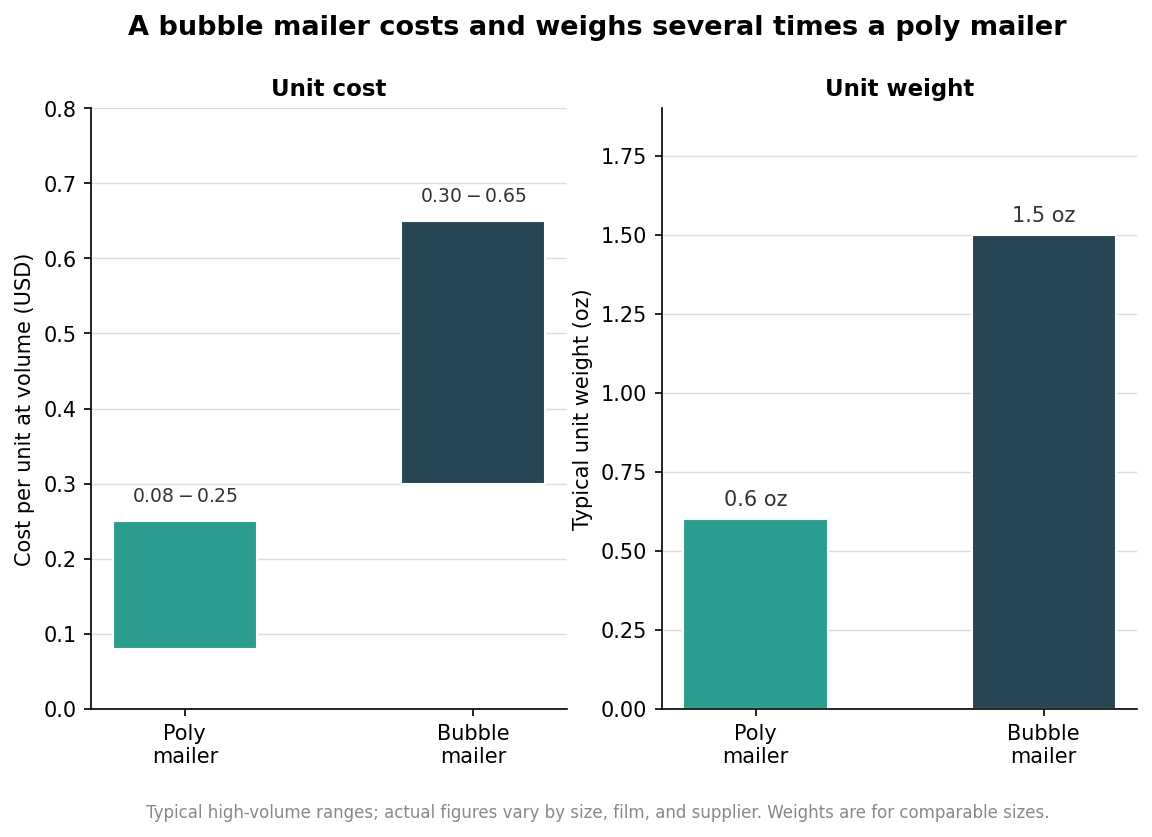
A poly mailer weighs well under an ounce, roughly 0.6 ounces in common sizes. A bubble mailer of similar size weighs around one and a half times to three times as much. That extra ounce or two matters because carriers bill in rounded-up weight steps, and a package that would have squeaked under a threshold can tip into the next one. An added ounce near a postage break can cost on the order of 40 cents per package. Ship 300 of those a month with even half affected and you are looking at roughly 60 dollars a month, or 700 dollars a year, in surcharges you never see itemized.
Weight is a shipping cost, not just a spec
The bigger shipping lever is dimensional weight, and this is where mailers of either kind beat boxes decisively. Carriers charge on the greater of a package’s actual weight and its dimensional weight, which is its volume divided by a fixed divisor, 139 for UPS and FedEx Ground and around 166 for USPS. A box is a rigid volume; a mailer collapses to nearly flat around its contents. That difference reprices the same product.
Take a folded hoodie that actually weighs about a pound and a half. In a 12 by 10 by 4 inch box, its 480 cubic inches divided by 139 come out to 3.5 pounds of dimensional weight, billed as 4. Slip the same hoodie into a flat poly mailer and there is almost no volume to speak of, so it bills on its actual weight, rounded to around 2 pounds. Same garment, half the billed weight, and that gap repeats on every parcel.
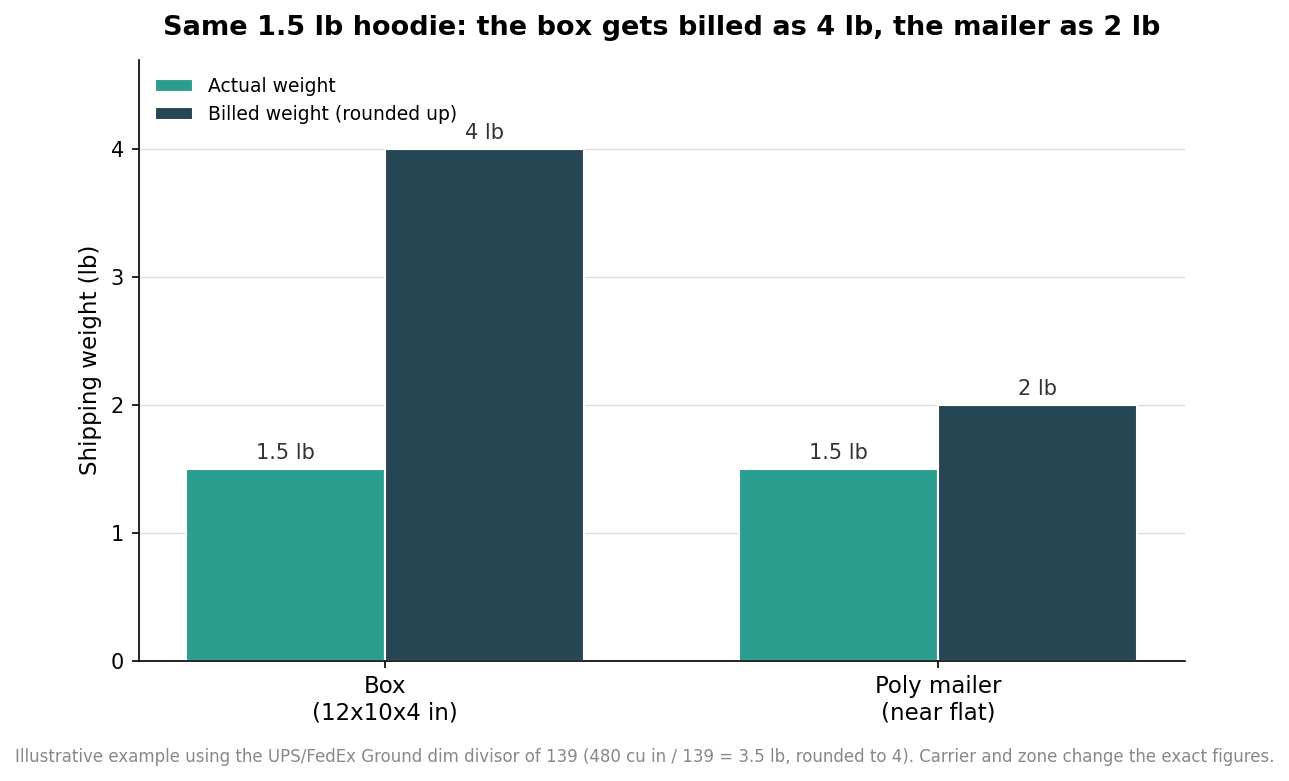
This is the real reason poly mailers dominate soft-goods shipping. The unit-cost savings are nice, but the shipping savings are the prize, and they accrue automatically on every order without any negotiation with the carrier.
A product-by-product selection guide
Reach for a poly mailer when the product is soft, flat, or unbreakable: apparel and textiles, soft accessories, books, printed matter, and most cut-and-sew goods. These items shrug off the handling a poly mailer does not cushion, so you are paying only for containment and moisture resistance, which is all they need. Poly mailers also have the recycling edge, since the thin film is accepted at store drop-off points, whereas most curbside programs will not take them at the bin.
Reach for a bubble mailer when the product is small but semi-fragile: cosmetics and glass vials, jewelry, small electronics and their accessories, hardware, and anything with corners or a screen that a drop could crack. Here the cushioning is not overhead; it is the thing preventing a return. The extra weight and cost buy down your damage rate, and for these items that trade is worth making. The recycling picture is worse, because the mixed paper-and-plastic construction is hard to process, so if sustainability messaging matters to your brand, weigh that alongside the protection.
A useful test is to ask what failure looks like for your specific item. If the worst a rough transit can do is wrinkle the product, a poly mailer is right. If the worst it can do is crack, scratch, or shatter it, pay for the bubble.
When neither mailer is the answer
Mailers win on cost and dimensional weight, but they are not universal. A box earns its keep when the product is genuinely fragile, when it is heavy enough to strain and burst a mailer’s seams, when an order combines several items that need rigidity to travel together, or when the unboxing experience is part of the brand and a flexible envelope would undercut it. Long, multi-facility routes with heavy sortation also favor the structure of a box for anything remotely breakable.
For most e-commerce catalogs, though, the honest answer is that a large share of orders are soft goods that have been shipping in far more packaging than they require. Sorting your catalog into the three buckets, poly mailer for the unbreakable, bubble mailer for the small and semi-fragile, and box for the genuinely fragile or rigid, is a one-afternoon exercise that quietly lowers both your packaging spend and your postage on every order that follows. Treat the figures here as current typical ranges rather than fixed quotes, confirm the dimensional-weight math against your own carrier and zones, and let the product, not habit, choose the mailer.
Leave a Reply