A poly bag that fails Amazon’s inbound checks does not just get a warning. The unit can be refused at the fulfillment center, flagged as a prep defect, or hit with a per-unit repackaging fee, and the inventory sits unsellable until it is fixed. Most of these rejections trace back to a handful of measurable specifications, and every one of them can be verified before a shipment leaves your warehouse. This guide walks through what Amazon actually inspects on a poly-bagged unit and the numbers that keep a shipment moving.
The five specifications Amazon checks
When a poly-bagged unit arrives at a fulfillment center, staff and automated systems are effectively looking for five things: that the bag is sealed completely, that it is transparent enough to identify the contents, that the barcode is scannable through or on the bag, that the bag carries a suffocation warning when its opening is large enough to require one, and that the bag is not wildly oversized for the product inside. None of these are subjective. A bag either seals shut or it does not; a barcode either scans on the first pass or it does not. Treating them as a pass/fail checklist rather than a judgment call is the fastest way to bring your defect rate down.
Thickness and transparency: the 1.5-mil floor
Amazon’s baseline is a poly bag of at least 1.5 mil thickness, where a mil is one thousandth of an inch. That floor exists for a practical reason: thinner film tears during the tumble of conveyor belts and chutes, and a torn bag exposes the product and its barcode. For heavier or edged items, stepping up to 2 mil or 3 mil buys puncture resistance at a modest cost increase, typically a fraction of a cent per bag at volume. The bag also has to be see-through so that receiving staff can identify the unit without opening it. The main exception is adult products, which Amazon requires to ship in opaque, non-transparent bags. If you print heavily on a bag, keep a clear window over the barcode so it stays readable.
When a suffocation warning is legally required
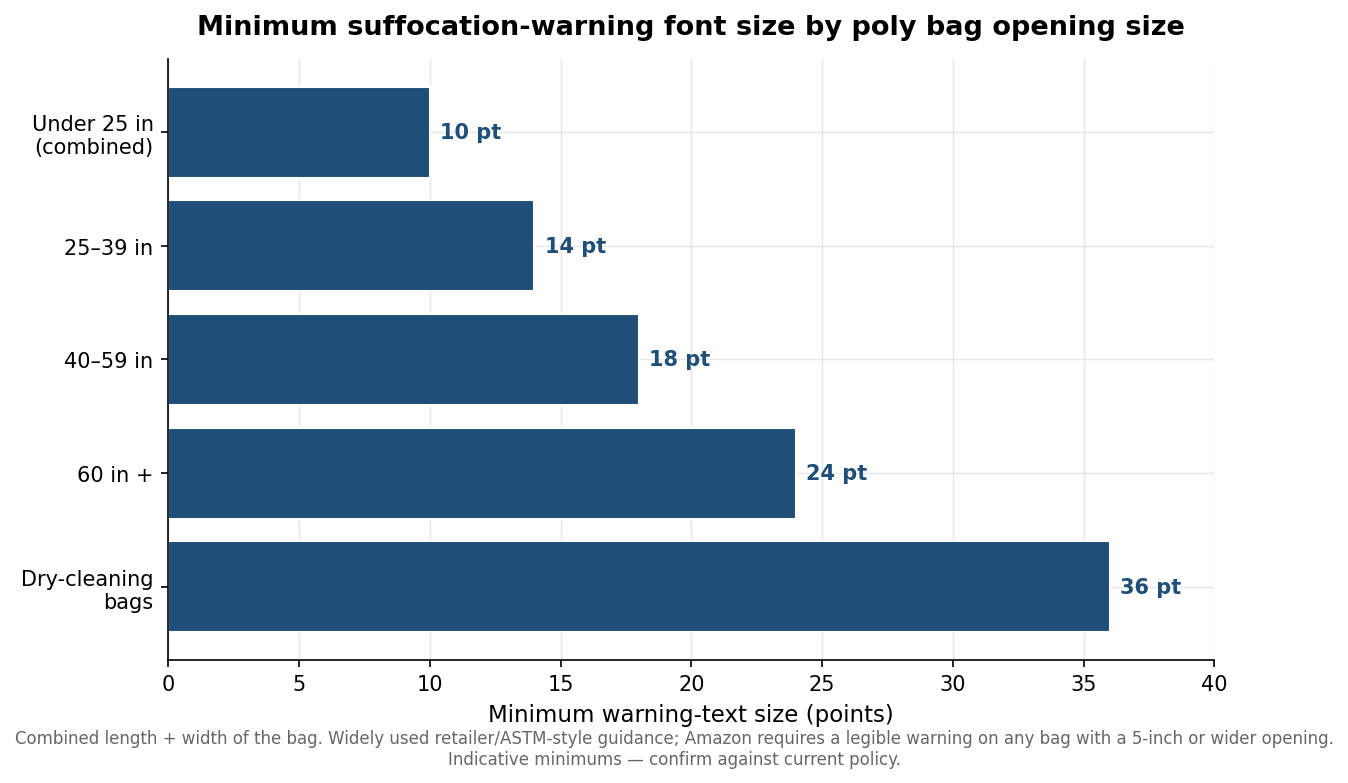
Amazon requires a printed suffocation warning on any poly bag with an opening of 5 inches or wider measured flat. The warning has to be legible, which in practice means the font scales with the size of the bag. The widely used guidance ties the minimum text size to the combined length and width of the bag: roughly 10-point for small bags under 25 inches combined, 14-point in the 25-to-39-inch range, 18-point from 40 to 59 inches, and 24-point at 60 inches and above. Dry-cleaning-style bags, which pose the highest risk, are often held to a 36-point minimum. The exact wording is not fixed, but a compliant warning tells the reader to keep the bag away from babies and children, states the suffocation risk, and notes that the bag is not a toy.
It is worth separating Amazon’s rule from state law, because they are not the same. Several states set their own thresholds for thin plastic bags, generally those at or under 1 mil. California requires a warning on bags with an opening wider than 25 inches or a capacity of 125 cubic inches or more, while Massachusetts, New York, and Chicago key their rules to openings of roughly 5 to 7 inches or combined dimensions of 25 inches. If you sell into multiple channels, the safe move is to print to the strictest standard that applies to your product rather than track each jurisdiction separately. Target, for example, asks for a 20-point minimum on all poly bags regardless of size.
Sizing the bag: the three-inch slack rule
Oversized bags are a common and avoidable rejection. Amazon’s guidance is that the bag should not add more than about 3 inches beyond the product on the relevant dimensions. A bag that swallows the product in loose film is harder to scan, harder to stack, and reads as sloppy prep. In practice this means measuring the longest dimension of your item and choosing a bag width and length that hug it with a few inches of tolerance for sealing, no more.
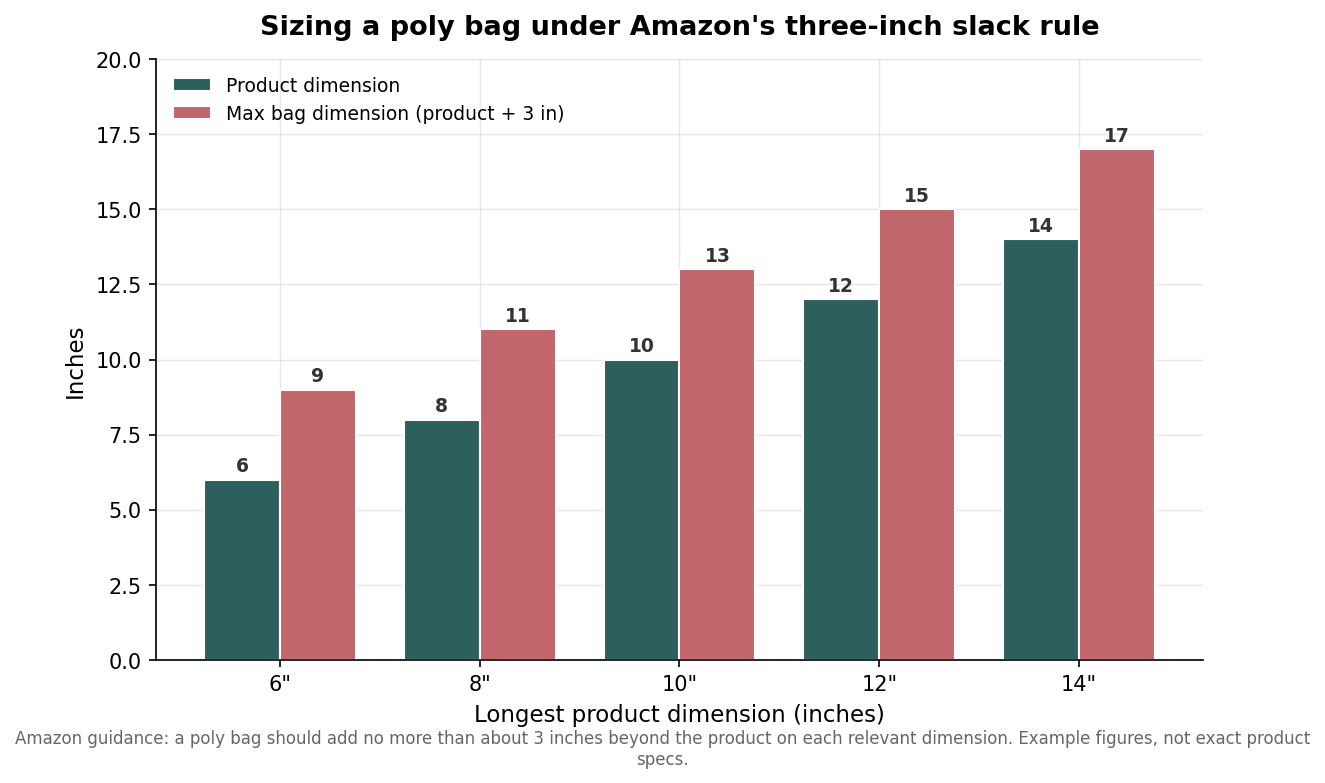
The chart above shows the ceiling, not a target. A product with a 10-inch dimension can sit in a bag up to about 13 inches on that axis, but a 12-inch bag is usually the cleaner choice. When you are ordering custom bags in a fixed size, pick the stock size that lands just above your product’s footprint plus a small seal allowance. If your catalog spans a range of sizes, it is often cheaper to standardize on two or three bag sizes than to chase a perfect fit for every SKU, provided each product still falls within the slack limit.
Sealing, barcodes, and the final walk-through
The bag has to be sealed completely, with no open end. A heat sealer gives the cleanest result, but a permanent adhesive lip strip is acceptable and is standard on most e-commerce mailers and self-seal bags. The unit’s barcode, whether an FNSKU label or a scannable manufacturer barcode, must be visible and flat enough to read without the operator fishing the product out of the bag. Wrinkles and folds over the barcode are a frequent cause of scan failures, so position the label on a flat face and smooth the film before sealing.
Before a shipment goes out, a quick pass against the same five checks Amazon uses will catch almost every problem: sealed, transparent, scannable, warned, and correctly sized. The specifications here are current retailer guidance and indicative minimums rather than a substitute for Amazon’s own published policy, which can change, so confirm the details in Seller Central before a large run. Getting the bag right is inexpensive insurance against fees and held inventory, and it is entirely within your control at the packing bench.
Leave a Reply