If you ship products in printed poly bags, the suffocation warning is not a design afterthought. For many sellers it is the line between a shipment that clears and one a marketplace rejects at the dock. Five states write the requirement into law, and the largest online marketplaces enforce their own versions on top of that. The rules are not complicated, but they are specific about three things: which bags are covered, what the warning has to say, and how large the type must be.
Which bags are legally required to carry a warning
Five US states have suffocation-warning statutes on the books: California, New York, Massachusetts, Virginia, and Rhode Island. Each targets thin plastic film, the kind light enough to cling to a child’s nose and mouth. The common trigger is thickness, and the statutes generally apply to bags measuring less than one mil, or 0.001 inch, the range where film is flimsy enough to seal against skin. A bag printed at 1.5 or 2 mil sits above that statutory floor, but that does not make the warning optional, because the platforms you sell through set their own rules regardless of gauge.
There is no federal law mandating the exact wording, which is why the five states differ in their language. If you sell into more than one of them, and any national e-commerce brand does, the practical answer is to carry a warning that satisfies the strictest state rather than printing a different bag for each jurisdiction. One compliant panel on every unit is cheaper and far easier to manage than a patchwork.
What the warning actually has to say
The states do not share a single mandated sentence, but they converge on the same elements: the word WARNING or CAUTION, a statement that the bag poses a suffocation danger, an instruction to keep it away from babies and children, and in most versions a line about not using it in cribs, beds, carriages, or playpens. New York and Massachusetts use nearly identical phrasing. California’s older statute reads, in part, “CAUTION – KEEP AWAY FROM SMALL CHILDREN. THE THIN FILM MAY CLING TO NOSE AND MOUTH AND PREVENT BREATHING.”
A widely used general-purpose block that covers the common requirements reads: “Warning: To avoid danger of suffocation, keep this plastic bag away from babies and children. Do not use this bag in cribs, beds, carriages, or playpens. This bag is not a toy.” Because the exact statutory language varies, treat that as a sensible default rather than a legally certified one, and confirm the current wording for any specific state that concerns you.
How large the type has to be
This is where most sellers get tripped up. The warning is not enough on its own. It has to be legible at a size the rules tie to the bag’s dimensions, and the measure used is the sum of the bag’s length and width. The minimum type size steps up as the bag gets bigger.
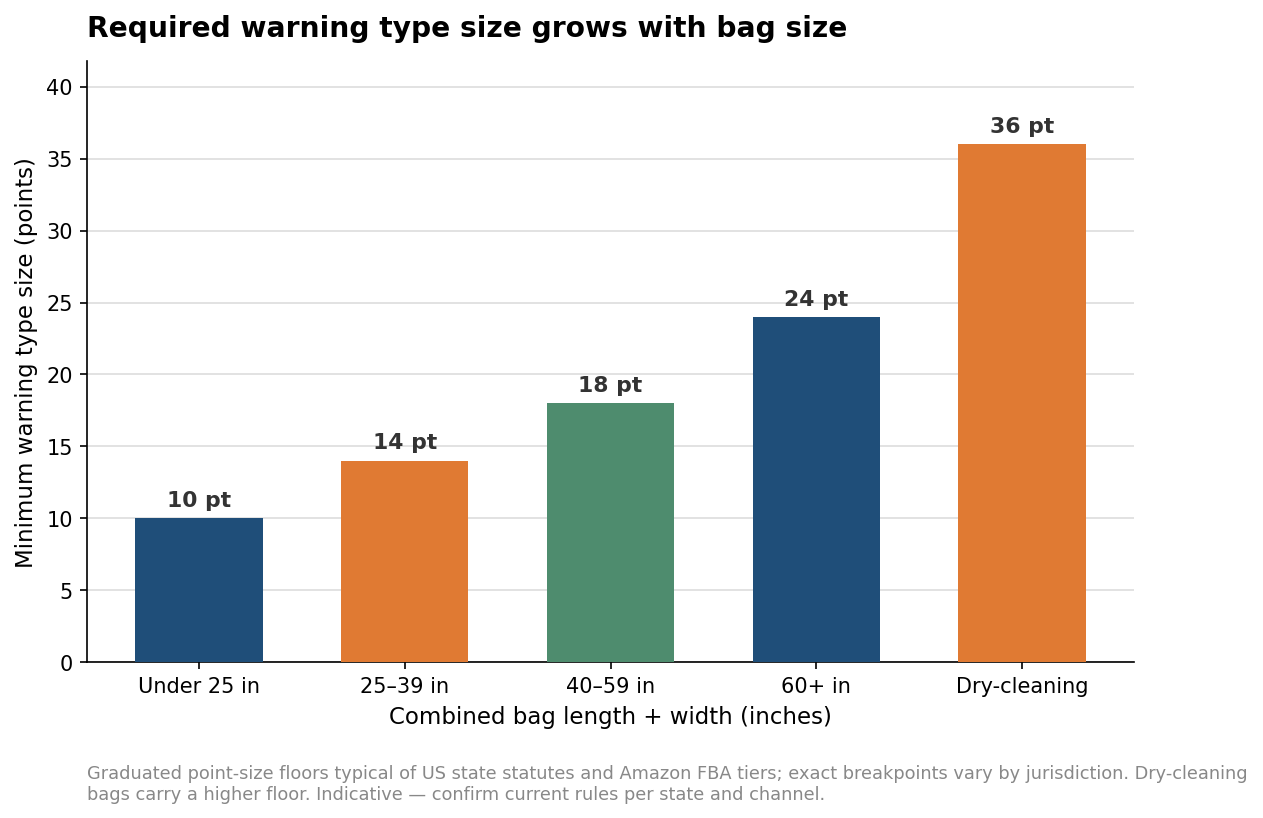
For a typical small mailer or apparel bag under 25 inches combined, a 10-point minimum is the common floor. A large garment or furniture bag crossing 60 inches combined can require 24-point type, and dry-cleaning bags, historically the highest-risk category, often carry a 36-point requirement. The exact breakpoints shift a little from statute to statute, so treat the tiers above as a working guide rather than one universal table. When a bag sits near a boundary, size the type up rather than down; the cost of oversizing a warning is nothing, and the cost of undersizing it is a rejected lot.
Marketplace rules go further than the law
Even when your bag is thick enough to sit outside the state statutes, the channel you sell on likely has its own requirement. Amazon is the one most sellers meet first. Its FBA guidelines call for poly bags of at least 1.5 mil and require a suffocation warning on any bag with an opening of five inches or larger, using the same graduated 10-to-24-point type scale. Target is stricter on type size, applying a 20-point minimum to every poly bag regardless of dimension. Walmart mirrors the state approach, focusing on bags one mil or thinner with five-inch-plus openings. Marketplaces such as eBay and Etsy publish no specific spec and leave the liability with the seller.
The upshot is that a single bag can face four different labeling standards at once, and the one that governs your print file is whichever is strictest among the channels and states you actually touch.
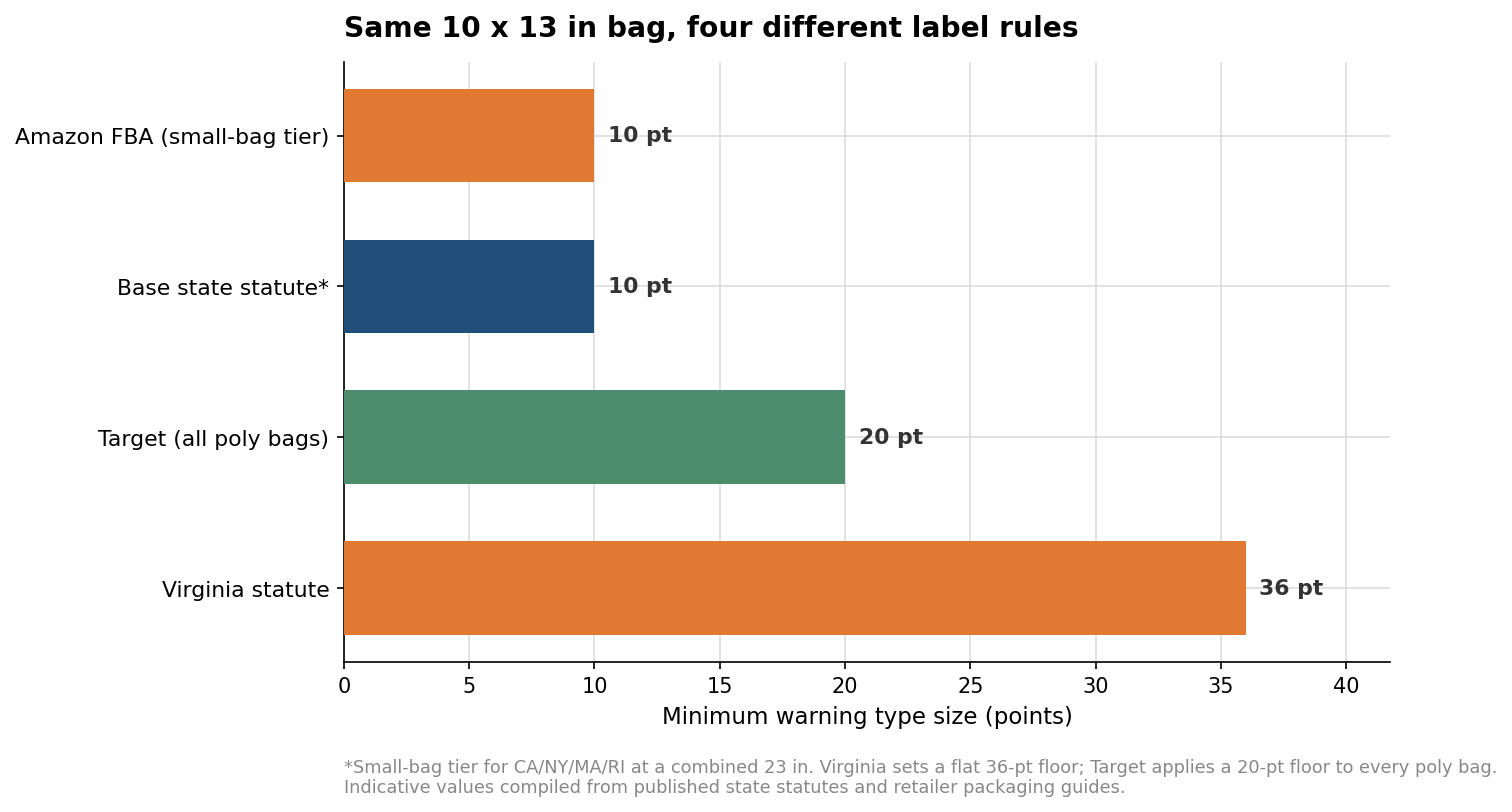
Read the chart the practical way: design to the highest bar you are exposed to. A brand selling a standard 10-by-13 bag nationwide through Amazon and Target should print to Target’s 20-point floor, because meeting it automatically clears Amazon’s small-bag tier and the base state statutes at the same time. You end up managing one artwork file instead of chasing exceptions channel by channel.
Getting the warning onto your custom bags
On a custom-printed poly bag the warning is usually printed directly into the film alongside your logo and artwork, which is cleaner and cheaper at volume than applying a separate sticker to every unit. Placement matters less than legibility. A common approach is to run the warning on the back panel or on the lip near the seal, where it stays plainly visible without competing with the brand-facing design. If you are ordering a run that will ship into regulated states or onto Amazon, specify the warning, its wording, and the required point size in your artwork brief up front, and ask the printer to confirm the rendered type size on the proof. Point sizes that look fine on screen can fall below the minimum once the file is scaled to the finished bag.
Adding the warning is generally negligible on a printed run because it is just one more element in the same print pass. The real cost is getting it wrong: a rejected FBA shipment or a stop-sale order is far more expensive than a corrected plate. Build the warning into the first version of the artwork, size it to the strictest standard you sell under, and it stops being something you have to reconsider on every reorder.
Leave a Reply