Two poly bags can share the same 2 mil thickness and behave nothing alike. One is glossy and soft and drapes around a folded shirt; the other is stiff, slightly hazy, and crackles when you handle it. The difference is not the gauge on the spec sheet but the resin the film is made from. Poly bags are almost always one of three polyethylenes: LDPE, LLDPE, or HDPE. Knowing how they differ is the fastest way to stop guessing at thickness and start choosing a bag that actually suits what you put in it and how you want it to look with your logo on it.
Three polyethylenes and why they behave differently
All three resins are polyethylene, but their molecules are packed differently, and that packing sets nearly every property that matters. LDPE (low-density polyethylene) has a branched molecular structure that keeps the film flexible, clear, and easy to process, at the cost of comparatively low strength. HDPE (high-density polyethylene) has a tightly packed, minimally branched structure that makes it rigid, strong, and stiff, with a characteristic matte, crinkly feel. LLDPE (linear low-density polyethylene) sits between them: its short, uniform branches let the film stretch and slide under stress instead of tearing, which gives it excellent puncture and tear resistance.
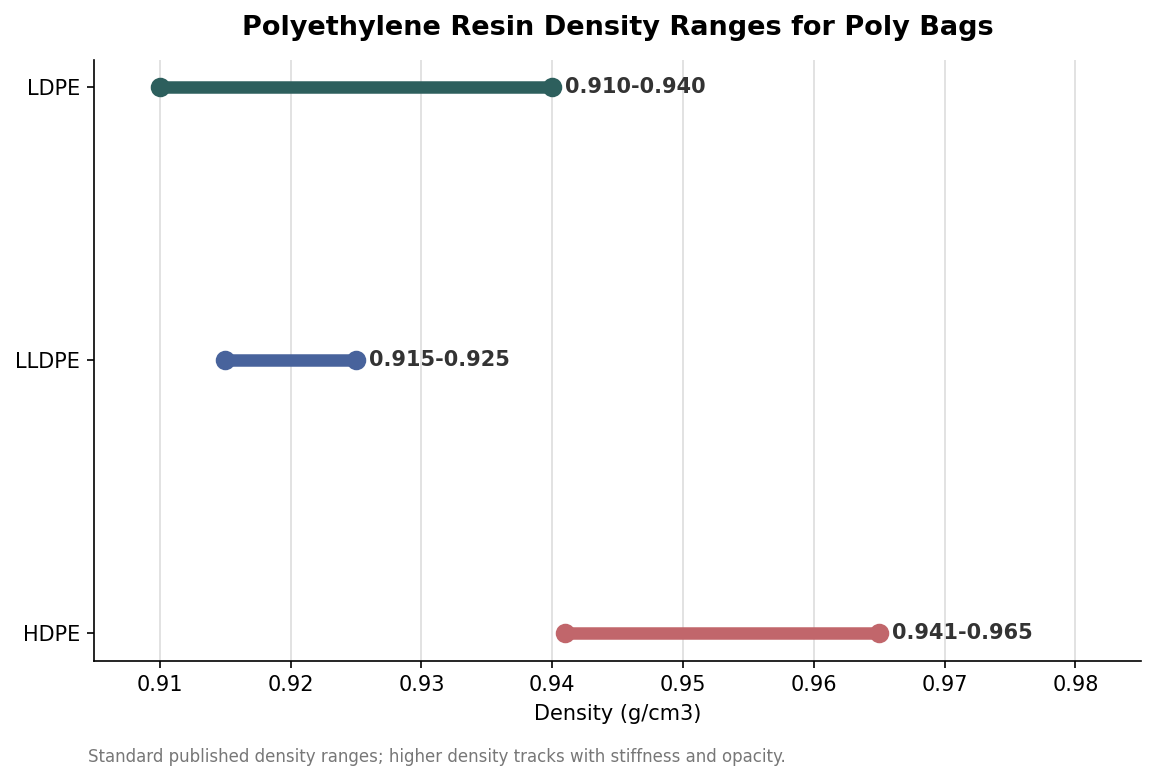
Density is the shorthand for all of this. LDPE runs roughly 0.910 to 0.940 grams per cubic centimeter, LLDPE a narrow 0.915 to 0.925, and HDPE a denser 0.941 to 0.965. Higher density tracks with stiffness and opacity; lower density tracks with softness and clarity. When a supplier quotes you a resin, that single number tells you most of what the bag will feel like before you ever hold a sample.
Clarity and print: how the resin changes how your logo looks
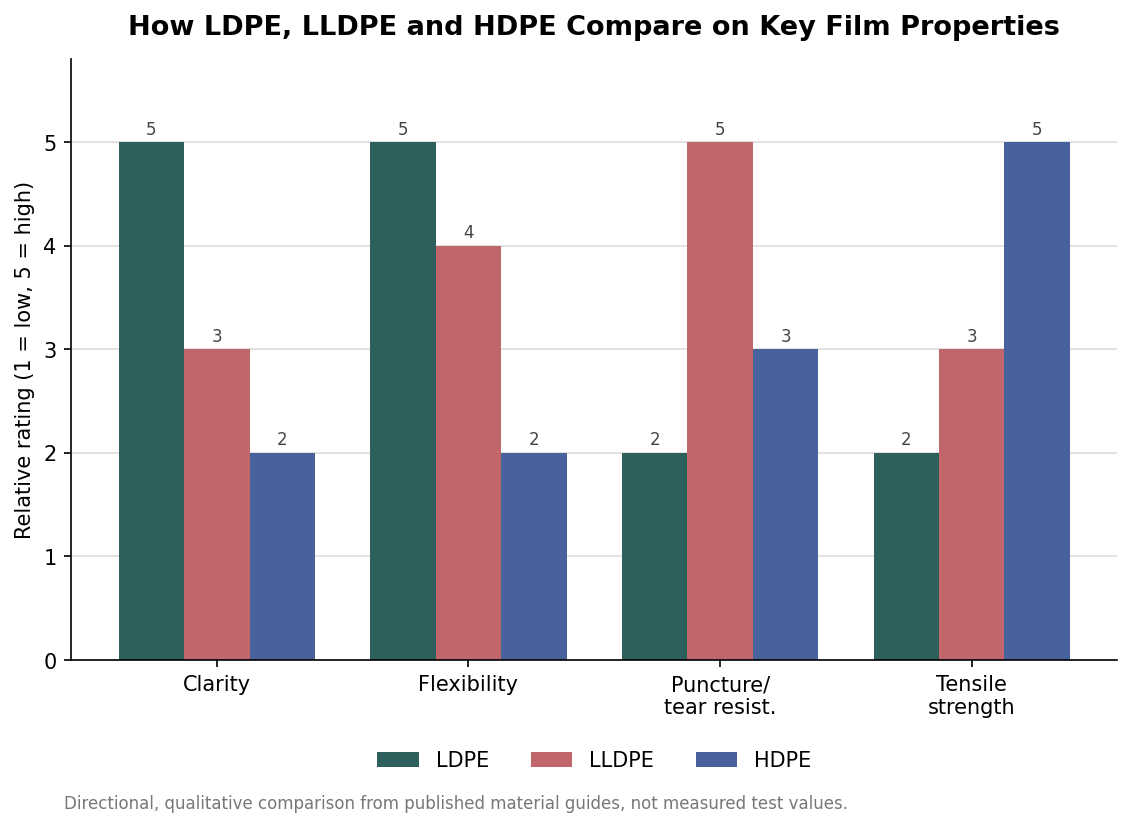
For a branded bag, appearance is not a side issue, and here the resins genuinely diverge. LDPE is the clearest and glossiest of the three, which is why retail bags meant to show the product inside are usually LDPE. Its smooth surface also takes flexographic printing cleanly, so solid color fields and fine logo detail land crisply. HDPE is the opposite: it is hazier and often opaque with a matte finish, so a printed logo reads with a flatter, more utilitarian look, and you generally cannot show the product through it. LLDPE falls in the middle, with moderate clarity that works for many mailers and industrial bags where a showroom-clear window is not the point.
If your goal is a bag a customer sees on a shelf or opens at their door as part of the unboxing, LDPE or an LDPE-rich blend is usually the right starting point. If the bag is protective packaging that lives inside a carton, the matte, tougher look of HDPE or the resilience of LLDPE matters more than gloss, and you can spend your budget on strength instead of clarity.
Strength, puncture, and stretch: matching resin to the contents
Strength is not one property but three, and each resin wins a different one. HDPE has the highest tensile strength, so it resists being pulled apart and holds dense, heavy contents like hardware or bulk grains without stretching out of shape. LLDPE has the best puncture and tear resistance, because its molecular structure lets the film deform around a sharp corner rather than splitting; that makes it the usual choice for anything with edges, or for bags that get handled roughly in shipping. LDPE trails both on raw strength but leads on flexibility and clarity, which is exactly what lighter-duty retail and apparel packaging wants.
The practical read is to start from the failure you are trying to avoid. If bags are bursting at the seams under weight, tensile strength is your problem and HDPE or a thicker gauge helps. If they are getting punctured by product corners, LLDPE content is the fix, often more effective than simply adding thickness. If the bag looks cheap or cloudy next to your product, you have overspent on strength and want more LDPE. Adding mils is the blunt instrument; changing or blending resin is the precise one.
Blends, thickness, and choosing a spec you can reorder
In practice most poly bags are not a single pure resin but a blend engineered to balance these traits, commonly LLDPE mixed into LDPE to add toughness without giving up much clarity. That is why you should treat resin and thickness as two separate dials rather than one. Thickness, measured in mils, controls how much material is there; resin controls how that material behaves. A 2 mil LLDPE-rich bag can outperform a 3 mil pure LDPE bag on puncture resistance while using less plastic, which matters for both cost and weight.
When you find a bag that works, write down the full specification, not just the dimensions and mil. Record the resin or blend, the thickness, the finish (clear versus matte), the seal type, and the print details, because a reorder that matches only the size and gauge can still come back looking and feeling different if the resin changes. Ask for a physical sample before a first production run and keep one on file as your reference. Lead times for printed poly bags commonly run one to a few weeks depending on quantity, print complexity, and season, and that figure is indicative rather than a promise, so build a little schedule buffer into any packaging you cannot afford to run out of. Getting the resin right the first time is what makes every reorder after it boringly consistent, which is exactly what you want from packaging.
Leave a Reply