Film type and thickness get most of the attention when people order poly bags, but the bag’s construction style is a separate decision that often matters more for how well the packaging actually works. A bag’s shape determines whether a bulky item fits, whether the seam holds under weight, and whether a packing line can run at speed. Get the style right and everything downstream gets easier; get it wrong and you are fighting the bag on every order.
Flat bags: the sensible default
A flat, or layflat, bag is exactly what it sounds like, a simple two-panel bag with no expansion. It lies flat, stores in less space, costs the least film for a given face size, and shows off a printed logo cleanly because the front stays smooth. For flat or lightweight products, apparel, printed materials, manufacturing components, and general everyday packaging, it is usually all you need. The limitation is depth. A layflat bag has almost no room for a three-dimensional item, so anything bulky either will not fit or stretches the film until the print distorts and the seam is stressed. If the item is essentially flat, choose a flat bag and move on.
Gusseted bags: when depth changes the math
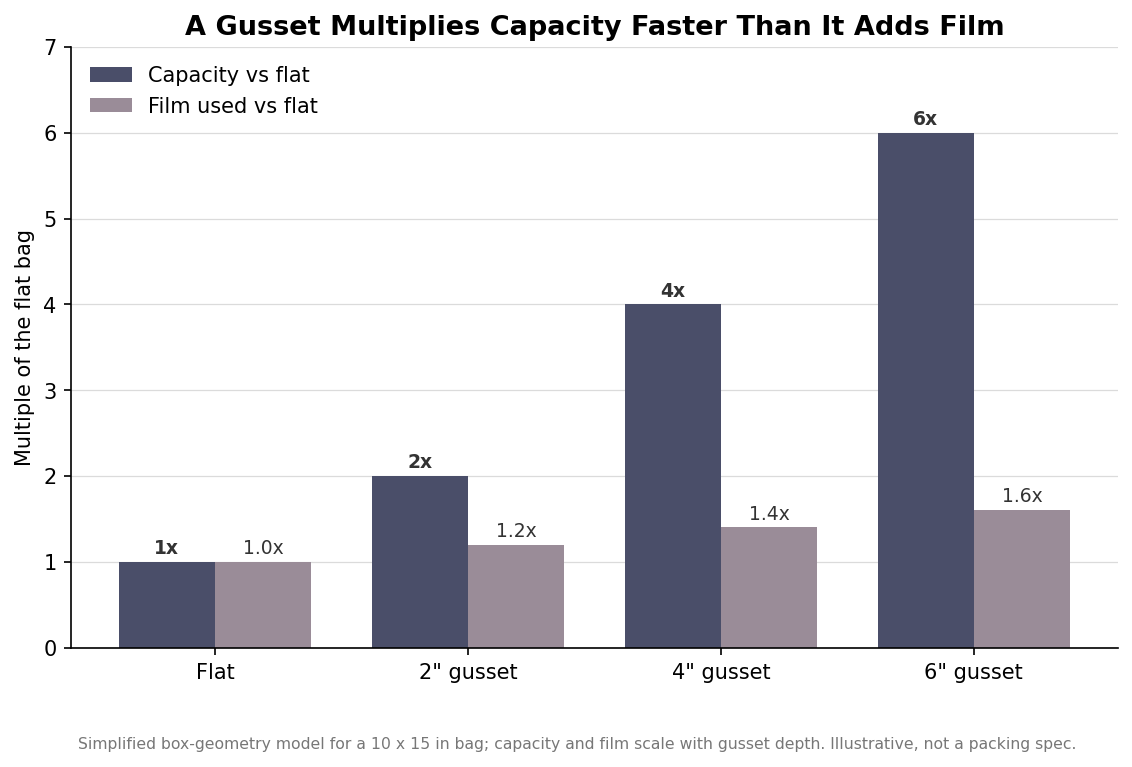
A gusset is a folded pleat, on the sides or the bottom, that expands when the bag is filled. That fold is what lets a bag hold a boxy or irregular item without deforming, and it is why gusseted bags are the standard for coffee, nuts, baked goods, bulk hardware, and anything that needs to stand up or hold its shape. The reason a gusset is worth the small upcharge is geometry: adding depth multiplies capacity far faster than it adds material. In a simplified model of a ten-by-fifteen-inch bag, moving from flat to a four-inch gusset roughly quadruples the packed volume while using only about forty percent more film.
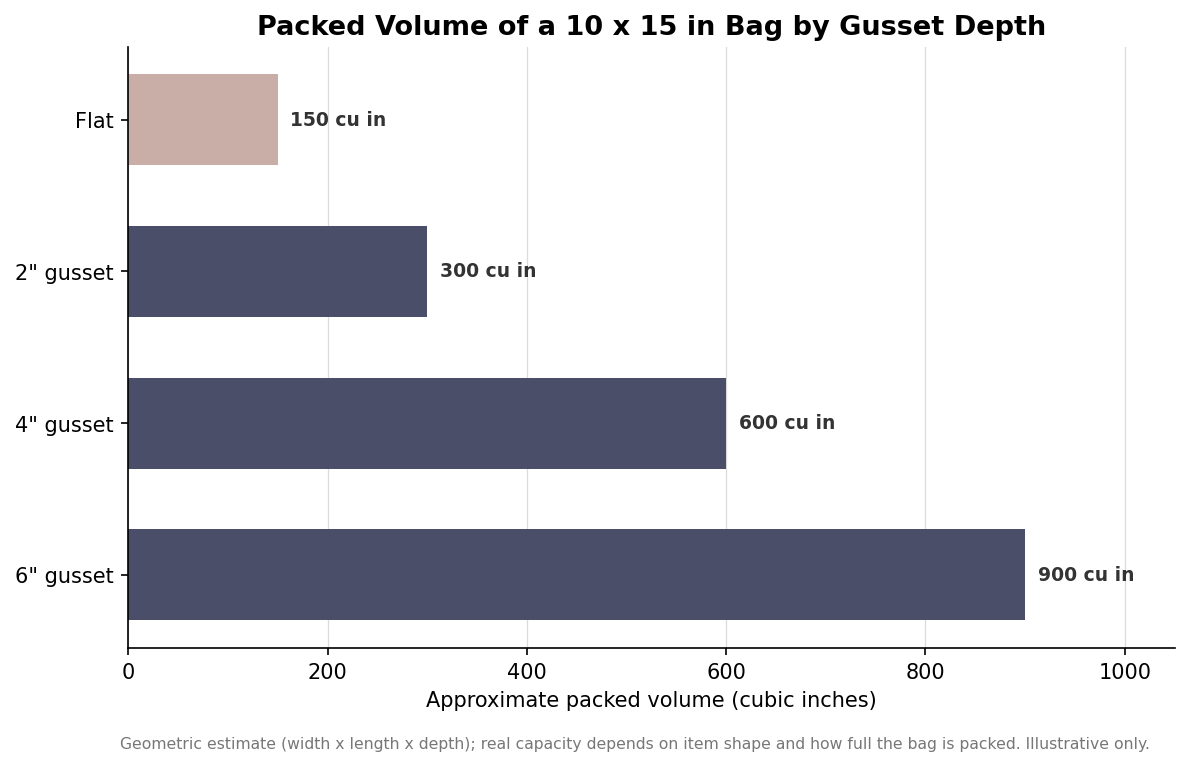
Put in absolute terms, that same bag holds only a sliver of volume when flat but hundreds of cubic inches once a gusset opens it into a box shape. The practical takeaway is to measure your item in three dimensions before ordering, then pick a gusset deep enough to swallow the thickness without the bag straining. A gusset that is too shallow leaves you back at the flat-bag problem; one that is far too deep wastes film and leaves loose material flapping around the product.
When you specify a gusseted bag, give the supplier the item’s width, depth, and height, not just a bag size, so they can translate it into the correct face and gusset dimensions. A small sample order to confirm the fit is cheap insurance before committing to a full run.
Bottom-seal versus side-seal
Where the seam sits is a strength decision that is easy to overlook. A bottom-seal bag carries a single seal across the base, which puts the strongest part of the bag directly under the weight of the contents, making it the better pick for heavier or denser items. A side-seal bag has seals running up both sides, which produces a very clean face for printing and works well for lighter goods, but the side seams can be a weaker point if the bag is loaded heavily. As a rough rule, lean bottom-seal for weight and durability and side-seal for appearance and lighter contents, and tell your supplier what the bag will actually carry so they can recommend the seam that will not split in transit.
Wicketed bags: built for speed
If bags are being filled by hand one at a time, style is mostly about the product. The moment volume rises, the loading method becomes the constraint, and that is where wicketed bags earn their place. A wicket is a set of metal or plastic pins that hold a stack of bags together through holes punched in a header, keeping every bag aligned and letting an operator, or a machine, grab and open them one after another without fumbling for the opening. Wicketed bags are standard in bakery and food lines, apparel fulfillment, and parts kitting precisely because they feed cleanly.
Their real advantage shows up with automation. On an automated bagging system, wicketed bags can be opened, filled, and sealed in a continuous cycle rather than handled individually, which is why high-throughput packing operations standardize on them. If you are still hand-packing but expect volume to grow, choosing a wicketed style now makes a later move to a semi-automated or automated bagger far less disruptive, since the bag format is already compatible.
How to spec the style
Work through four questions in order. First, measure the item in three dimensions and decide whether it is flat enough for a layflat bag or needs a gusset. Second, weigh the loaded bag and choose bottom-seal for heavier contents or side-seal for lighter, print-forward packaging. Third, decide how bags will be loaded now and in the near future, and specify wicketed headers if speed or automation is on the horizon. Fourth, only then settle film and thickness, because the right style with the wrong gauge still fails. Confirm the final combination with a small sample against your actual product before you place the bulk order, and treat the capacity figures here as geometric illustrations rather than a packing guarantee for your specific item.
One last point worth flagging: bag style also affects how a barcode or shipping label scans. Flat and side-seal bags give a smooth, wrinkle-free face that reads reliably at the register or on a conveyor, while a heavily filled gusseted bag can pull the surface taut or uneven, so leave a flat panel for the label or plan to apply it to a stiffer area. Thinking about the label surface at the same time as the style saves a surprising number of rescans down the line.
Leave a Reply